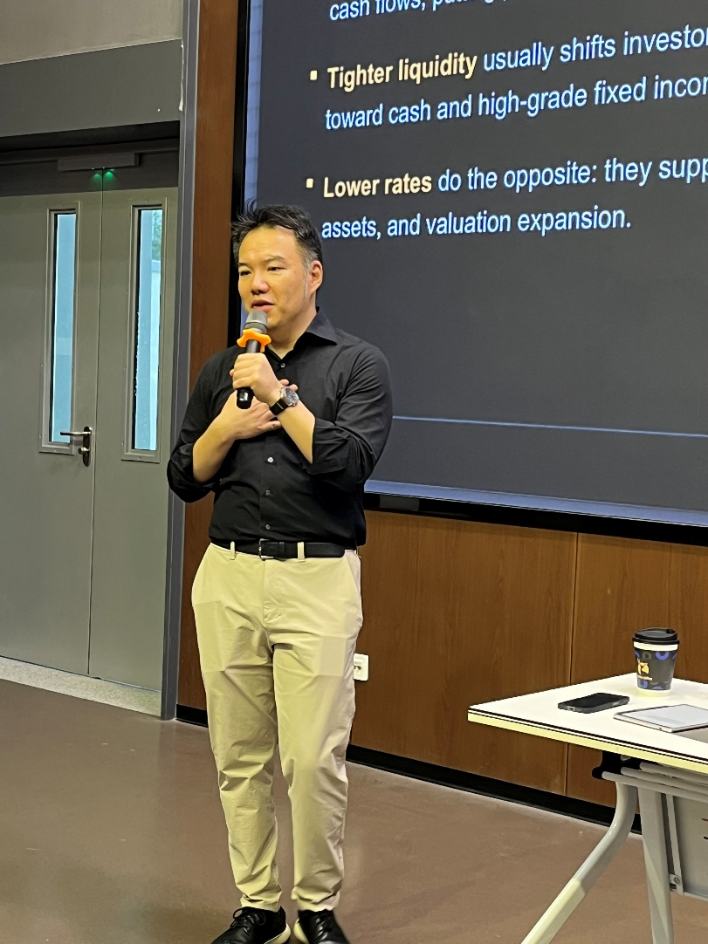
To broaden the academic horizons of teachers and students, bridge the gap between economic theory and macro-market practice, and deeply interpret the operational logic of capital markets in a complex market environment, the Business School of Shenzhen Technology University (SZTU) held the Financial and Capital Markets Forum: Special Lecture on the Relationship Between Interest Rates, Oil Prices, Capital Markets and Inflation in Room C5-101,June 13, 2026. The forum organized by Associate Professor WOO KOK LIAN and specially invited Mr. Chen Zhihao, Deputy General Manager of Guangzhou R&F Group, as the keynote speaker. Compared with previous financial-themed sharing sessions, this forum, based on the current global economic environment, adds two core variables—oil price fluctuations and inflation—to the original research on interest rates, investment, and asset prices. Combined with the complex geopolitical background, it analyzes the profound impact of macroeconomic factors on capital markets and the asset management industry from multiple dimensions.
During the lecture, Mr. Chen systematically sorted out the interactive logic among interest rates, oil prices, and inflation, and dissected the transmission paths with global market cases. On one hand, he elaborated in detail how interest rate fluctuations change corporate financing costs and investors' risk appetite, thereby affecting the pricing of various assets such as stocks, bonds, and real estate. On the other hand, he focused on analyzing how fluctuations in international oil prices—driven by geopolitics and supply-demand patterns—gradually transmit to price levels, trigger inflation changes, and ultimately act on the entire capital market. The speaker pointed out that amid increasingly complex geopolitical situations, oil prices are no longer merely a commodity price indicator, but a key link affecting global inflation, monetary policy, and interest rate adjustments. The superposition of multiple factors has significantly increased the difficulty of analyzing and judging capital markets and asset management.
Integrating professional knowledge of applied economics, Mr. Chen closely combined classroom theory with real-time economic dynamics, and translated abstract economic models into practical scenarios such as capital market operations, asset allocation, and wealth management. From corporate investment and financing decisions, personal broad asset allocation, to institutional asset management strategy adjustments, he explained the practical guiding significance of macro indicators in a progressive manner, guiding students to break free from the limitations of pure theoretical learning and learn to analyze complex economic phenomena from a holistic perspective. In the interactive Q&A session, teachers and students present actively raised questions on macro policy trends, asset hedging strategies, industry development trends, etc. Mr. Chen answered each question in detail based on practical industry experience, creating a lively atmosphere for on-site exchanges.
The Business School has long been regularly hosting a series of activities such as financial forums, industry lectures, and academic seminars. Adhering to the principles of theory-based, market-oriented, and practice-focused, it strives to promote the in-depth integration of applied economics expertise with practical fields such as capital markets and asset management. Relying on a diversified academic exchange platform, the college guides students to closely follow global economic trends and geopolitical changes, learn to analyze and solve problems with professional knowledge in complex market environments, effectively bridge the gap between classroom teaching and industry realities, and comprehensively enhance students' professional application capabilities, macro analysis capabilities, and comprehensive professional qualities.
In the future, the Business School will continue to integrate industry resources, enrich the forms of academic activities, and build more high-level financial and economic-themed exchange platforms. It will continuously deepen the integration of industry and education, as well as research and teaching, helping teachers and students keep pace with the forefront of economic development, consolidate professional foundations, and cultivate more versatile and high-quality talents who can meet the development needs of capital markets and financial asset management.
Text/Picture: Jack Woo
Review: Bella Lu